Showing posts with label Entertainment. Show all posts

Saturday, 14 May 2011

WFRP: Cemetary Polka

In my mind, Altdorf is a mad place, a cacaphony of bizarre antics of depraved individuals with warped motivations set against the backdrop of a world insane. And on top of that people are stupid and greedy. And there is no one better to capture that than Tom Waits. An acquired taste, I guarantee you, but to me  nothing says WFRP in Altdorf in music more than the Cemetary Polka.


And now the lyrics, adapted to the Old World

Cemetary Polka, by Thomas Warten
Uncle Werner, uncle Werner, independent as a hog on ice
He's a big shot down there at the slaughterhouse
Plays accordion for old Herr Weiss

Uncle Berthold, uncle Wilhelm
Made a fortune selling halfling pies
But they're tightwads and they're cheapskates
And they'll never give a klank to us 

Auntie Mame has gone insane
She lives in the doorway of an old hostel
And the guests are singing opera
All she ever says is "Go to hell!"

Uncle Violet sailed as a pilot
Never gave the pretty girls a glance
Now he runs a tiny little book shop
They say he never keeps it in his pants

Uncle Schill will never leave a will
And the tumor is as big as an egg
He has a mistress, she is Kislevitan
And I heard she has a wooden leg

Uncle Willi can't live without his pills
He is hard of hearing and he's almost blind
And we must find out where the money is
Get it now before he loses his mind

Uncle Werner, uncle Werner, independent as a hog on ice
He's a big shot down there at the slaughterhouse
He plays accordion for old Herr Weiss

/Magnus

Thursday, 20 May 2010

Don't Pay the Ferryman

The people of Altdorf enjoy telling ghost stories, both as entertainment and as sincere warnings of the horrors of the unknown. The Niederhafen Pike is one such legend, and this is often accompanied by the fable known as Don't pay the ferryman. The source of this ballad is unknown, but it is easy to imagine that it has some truth to it, given the amount of ferries that cross the Reik. There are bound to be incidents, even if they are more mundane than the legend makes out.

The popular and skilled lute player and folk singer Christoph Von Kleinestadt has followed up on his success at the taverns and bars in the docklands, and has written another catchy tune, inspired by the old legend of the sinister ferryman.

It was late at night on the Volkerweg
Speeding like a man on the run
A lifetime spent preparing for the journey 
He is closer now and the search is on
Reading from a map in the mind
Yes there's the ragged bridge
And there's the boat on the river 
And when the rain came down
He heard a wild dog howl
There were voices in the night - "Don't do it!"
Voices out of sight - "Don't do it!
Too many men have failed before
Whatever you do
Don't pay the ferryman
Don't even fix a price
Don't pay the ferryman
Until he gets you to the other side 
In the rolling mist then he gets on board
Now there'll be no turning back
Beware that hooded old man at the rudder 
And then the lightning flashed, and the thunder roared
And people calling out his name
And dancing bones that jabbered and a-moaned
On the water 
And then the ferryman said
"There is trouble ahead.
So you must pay me now" - "Don't do it!"
"You must pay me now" - "Don't do it!"
And still that voice came from beyond
Whatever you do 
Don't pay the ferryman
Don't even fix a price
Don't pay the ferryman
Until he gets you to the other side
Don't pay - the ferryman!
Adolphus Altdorfer
Wellentag, Sommerzeit 20, 2521 IC

Here's the video of the song performed live! It's kind of a silly song, but I love it. Too bad I couldn't find the original video, with De Burgh dressed as a vampire!

/Magnus

Friday, 17 July 2009

WFRP: Xinjiapor

On the docks of Altdorf, a visitor will hear many strange songs sung by the sailors scrubbing the decks of ships and boats. Listening to these whimsical tales takes you on a journey over the world, and hints of exotic and dangerous locales. No wonder the docks are filled with young boys and girls listening with fascination to verses painting a grim picture of a world they might hope to see themselves, if nowhere else than in their dreams.

One such song is called Xinjiapor, which might or might not be the name of a real harbour close to Cathay. There are many other things mentioned in this song that are mysterious, and I hope to delve deeper into many of the things mentioned here to decipher their meaning.


We sail tonight for Xinjiapor
We're all as mad as hatters here
I've fallen for a tawny whore
Took off to the land of blood
Drank with all the Cathay men
Walked the sewers of L'Anguille
I danced along a colored wind
Dangled from a rope of sand
You must say goodbye to me

We sail tonight for Xinjiapor
Don't fall asleep while you're ashore
Cross your heart and hope to die
When you hear the children cry.
Let marrow bone and cleaver choose
While making feet for children's shoes
Through the alley
Back from Hell
When you hear that steeple bell
You must say goodbye to me.

Wipe him down with kerosene
Till his arms are hard and mean,
From now on boy this iron boat's your home
So heave away boys.

We sail tonight for Xinjiapor
Take your blankets from the floor
Wash your mouth out by the door
The whole town is made of iron ore
Every witness turns to steam
They all become Tilean dreams
Fill your pockets up with earth
Get yourself a guilder's worth
Away boys, away, boys, heave away

The captain is a one-armed dwarf
He's throwing dice along the wharf
In the land of the blind, the one-eyed man is King
So take this ring

We sail tonight for Xinjiapor
We're all as mad as hatters here
I've fallen for a tawny whore
Took off to the land of blood
Drank with all the Cathay men
Walked the sewers of L'Anguille
I danced along a colored wind
Dangled from a rope of sand
You must say goodbye to me

Adolphus Altdorfer
Konistag, Nachgeheim 17, 2524 IC


This song is originally called Singapore, and is sung by Tom Waits on his album Rain Dogs. Do get it, it's wonderfully atmospherical. The music of Tom Waits is very WFRP in feel to me, sometimes silly, whimsical and dark as pitch.

I regret that I didn't manage to find a WFRP equvivalent of "hell", so I left that in there. Any suggestions are welcome! It should rhyme with "bell".

/Magnus

Friday, 2 May 2008

WFRP: The Foggy Dew

There are many ballads that stir the hearts and souls of the Empire's folk and fighters. One such is the newly composed The Foggy Dew, which was written after Reikland troops rallied to defend Altdorf from a vicious Chaos incursion during the Storm of Chaos. Most of the troops were killed, but the attack on the capital was stopped. Those who returned were hailed as heroes, but they had paid a terrible price and are still haunted by their ordeals. So The Foggy Dew is a lament for their great sacrifice.
As down the glen one Sigmar's morn to a city fair rode I
There Armed lines of marching men in squadrons passed me by
No fife did hum nor battle drum did sound it's dread tatoo
But the Hammer's bell o'er the Reik-river swell rang out through the foggy dew

Right proudly high over Altdorf Town they flung out the flag of war
'Twas better to die 'neath our Sigmar's sky than at Khypris or Barak Varr
And from the burghs of Reikland hills strong men came hurrying through
While the Blood God's Huns, with their long range guns sailed in through the foggy dew

So the bravest fell, and the requiem bell rang mournfully and clear
For those who died that Sigmar-tide in the springing of the year
And the world did gaze, in deep amaze, at those fearless men, but few
Who bore the fight that freedom's light might shine through the foggy dew

Ah, back through the glen I rode again and my heart with grief was sore
For I parted then with valiant men whom I never shall see more
But to and fro in my dreams I go and I kneel and pray for you,
For slavery fled, O glorious dead, When you fell in the foggy dew.
The song references the giant bell in the Great Cathedral of Sigmar, and two famous battle sites in the Badlands; Khypris and Barak Varr. The Blood God's Huns were a Chaos Mercenary regiment, infamous for using the Hochland Long Rifle in combat.

Adolphus Altdorfer
Bezahltag, Sommerzeit 2, 2523 IC

The song I have adapted is of course The Foggy Dew. I have changed the meaning of some verses to fit the Old World and the sometimes more simple conflicts that are played out in this fictitious world. My favourite version of the original is sung by Alan Stivell together with Shane MacGowan, but the Chieftains with Sinead O'Connor also perform a powerful version. The first time I remember hearing the melody though, was with Black 47 in their "Livin' in America (11 Years On)" from the album Fire of Freedom. I will return to the Irish tradition when adapting more songs in the future.

Magnus

Wednesday, 9 May 2007

Karl and Country

Today I happened to go by the Niederhafen docks, and caught sight of a ship sailing out of Altdorf towards Marienburg and presumably farther shores. As the crew worked under the sails, they sang this little ditty that caught my fancy. Stangely enough this song was accompanied on a concert flute by a man capering about on deck, sometimes standing on one leg. An impressive feat indeed, although I'm not sure where he pilfered the flute.

The wind is on the river and the tide has turned too late,
so we're sailing for another shore where some other ladies wait.
To throw us silken whispers: catch us by the anchor chains -
But we all laugh so politely and we sail on just the same.

For Karl and Country in the long dying day,
And it's been this way for five long years,
since we signed our souls away.

We bring back gold and ivory; rings of diamonds; strings of pearls -
make presents to the government
so they can have their social whirl

With Karl and Country in the long dying day.
And it's been this way for five long years
since we signed our souls away.

They build schools and they build factories
With the spoils of battles won.
And we remain their pretty sailor boys -
hold our heads up to the gun

Of Karl and Country in the long dying day.
And it's been this way for five long years
since we signed our souls away.

To Karl and Country in the long dying day.
And it's been this way for five long years
since we signed our souls away.

Adolphus Altdorfer
Konistag, Sommerzeit 9, 2522 IC

Since the last post gave the link to the excellent Under the Sails by Leif Ulrich Schrader, I couldn't resist adapting Jethro Tull's song Queen and Country to the Old World.

Well, "adapting" is a bit of a strong word. I substituted "Queen" for "Karl", and that's about it. It's a great song, though. In case you're wondering, that guy with the flute that Altdorfer took note off is the WFRP equvivalent of Ian Anderson, front man of Jethro Tull. I'll stat him one day.

Magnus

Sunday, 29 April 2007

Children's games

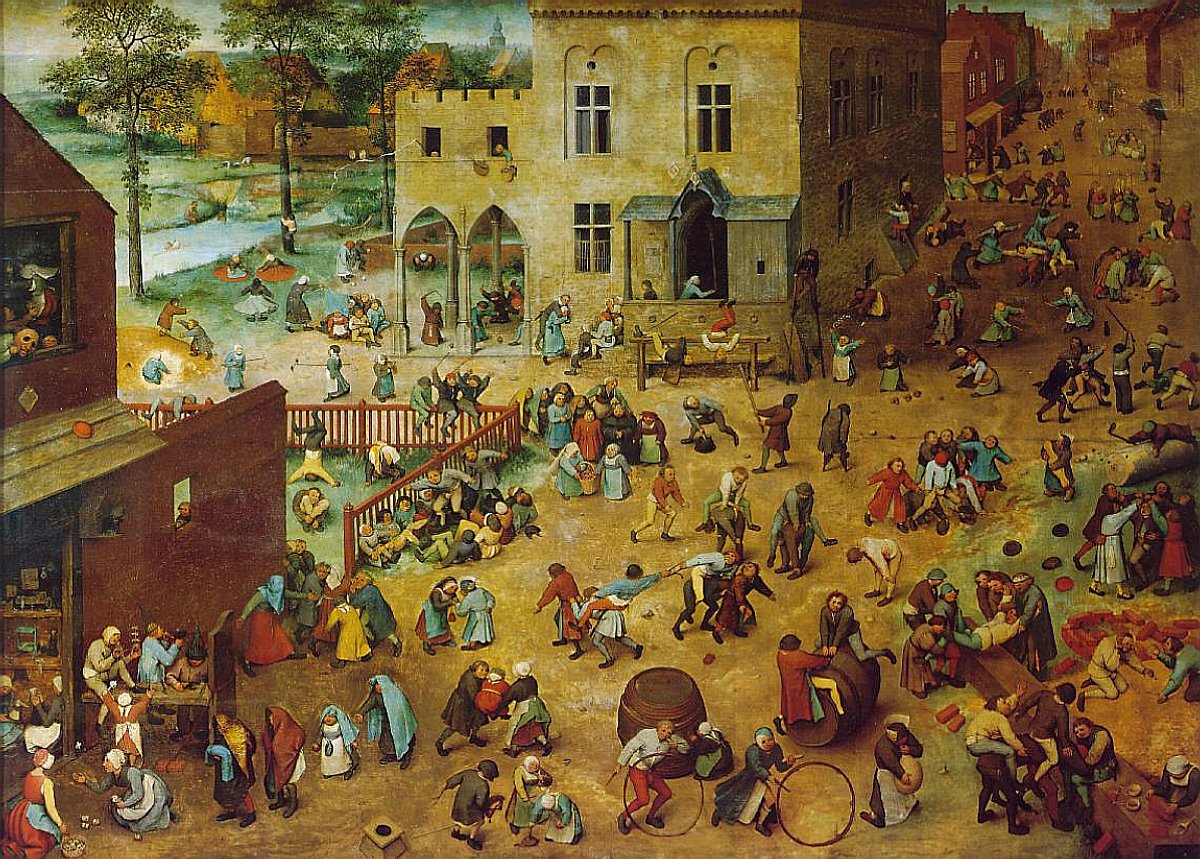
Pieter Bruegehl, Children's Games

It is impossible to venture out on the streets of Altdorf without being overrun by children. When I say children it is with the greatest of constraint that I chose such a benevolent word. Brats, racals, even criminals often seem a better word for them, and much better reflects their activities. Even though many children in our fair city begin working at an early age, often helping their parents out with various and sundry tasks, there are many, many who have nothing better to do than spend their time playing on the streets with their various toys.

Of these, wooden weapons seems the most common among the boys. Swords and shields are swung at unprotected heads, or indeed even at the knees of innocent passers-by, in furious battles enacting the war against Chaos. I have also observed a not insignificant group with painted tin soldiers, or troops whittled out of wood. They meet in parks and in public squares all over the city to fight out imaginary battles between the armies of the Empire and the forces of Chaos. A worrying amount of the boys involved in these different war games thoroughly enjoy playing Chaos warriors, and some even run bellowing around Altdorf, scaring women and babies, and panicking horses and cattle! A right nuisance, if you ask me!

And speaking of nuisances, the children of Altdorf seem to have made it their holy mission to remind the rest of the world of their existance; for this they use infernal rattles, pipes, bells, drums or whistles, even horns or trumpets stolen from some unfortunate coach driver add to the cacaphony of sounds of everyday life. Some foolish adults even pay children to come and scare off the ill influences of sickness and disease with their instruments of torture to the ear and sensibilities of educated people! The practice of making this noise seems to be most popular among the girls, for some reason.

Apart from the toys mentioned, the children of Altdorf play with balls made from cloth and inflated pigs’ bladders, playing games that involves much kicking and screaming. They also excel at the game called Nine Kings, where you use a ball to knock over as many of nine pins placed in varying patterns as possible in two tries. Very popular in the more affluent parts of our capital. In the poorer parts of Altdorf the children play with marbles, so called even though they are commonly made from stone or scrap glass or metal.

Adolphus Altdorfer
Bezahltag, Sigmarzeit 33, 2522 IC

While doing some quick research for this piece, I came across the painting Children's Games by Pieter Bruegel. This paints a much better picture of what an ordinary day in Altdorf can look like, so right-click the image above and save it to disk. Then open it in an image viewer of your choice and take a closer look. It is well worth the extra effort!

Magnus

Tuesday, 10 April 2007

The Estalian Coach

There are many stories and folk songs about life and death sung in the taverns of Altdorf. Many have erotic or horrific undertones, and many make fun of outrageously behaving nobles or clergy and a fumbling and incompetent City Watch.

But many also describe the world surrounding the Empire. Lately the renowned lute player and folk singer Christoph Von Kleinestadt has gained popularity performing his song "The Estalian Coach" at various venues in our capital. I have heard it many times during my outings to The Burning Table, and have taken the liberty of scribing the text to preserve it for those who come after me.

As my observant reader will notice, Von Kleinestadt brings together current events in Altdorf (see my short text on Heartless Jochen) as well as the sinister symbolics of Old World rural folk lore (The Great Jester mentioned in my writings on Gaspar und Gretchen makes an appearance). Wrapped up in this ditty is also a theological conundrum; is it possible that the gods are playing games with their followers, and that our very souls can be staked in a game of chance? Needless to say, the Church of Morr is not amused by the lyrics. Also note the use of the card game Pochen as a symbolic battle between the forces of Chaos and the Lord of Death.

There's an Estalian coach that runs between
Gualcasar and Bilbali.
In the dead of night the bugle blows,
And people hear,
she’s running still.

And then they hush their children back to sleep,
lock the doors, upstairs they creep.
For it is said that the souls of the dead,
fill that coach -
ten thousand deep!

Well a coaching man lay dying,
with his people by his side.
His family were crying,
knelt in prayer before he died.

But above his bed
just a-waiting for the dead,
was the Jester with a twinkle in his eye.
- Well Morr's not around,
and look what I've found,
This one's mine!

Just then the Lord of Death appeared
in a blinding flash of light.
And shouted at the Jester
- Get thee hence to endless night!

But the Jester just grinned,
and said, - I may have sinned,
but there’s no need to push me around.
- I got him first
so you can do your worst,
He's going underground!

- But I think I'll give you one more chance,
said the Jester with a smile.
- So throw away that stupid lance,
It’s really not your style.

- Jochen is the name, Pochen is the game,
we’ll play right here on his bed!
And then we'll bet for the bigger stakes yet;
The souls of the dead!

And I said,
- Look out, Lord, He’s gonna win,
The sun is down and the night's riding in.
That coach is dead on time,
many souls are on the line,
Oh, Lord he's gonna win!

Well the coaching man he cut the cards,
and he dealt them each a hand of five.
And for the Lord he was praying hard,
for that coach he'd have to drive…

Well, the Jester he had three aces and king.
And Morr, He was running for a straight.
He had the queen and the knave
and a nine and ten of spades,
All He needed was the eight…

And then Morr he called for one more card,
But He drew the diamond eight,
And the Jester said to the Lord of Death,
- I believe you’ve got it straight.

- So deal me one,
for the time has come to see
who'll be the king of this place.
But as he spoke, from beneath his cloak,
He slipped another ace…

Ten thousand souls was the opening bid,
Soon went up to fifty-nine.
But Morr did not see what the Jester did,
And said, - That suits me fine.
I’ll raise you high, to a hundred and five,
and forever put an end to your sins!

But the Jester let out a mighty shout,
- My hand wins!

And I said, - Lord, oh Lord, you've let him win,
The sun is down and the night is riding in.
That coach is dead on time,
many souls are on the line,
Oh Lord don't let him win…

Well that Estalian coach still runs between,
Gualcasar and Zaraguz,
In the dead of night the bugle blows,
and people fear,
she’s running still…

And far away in some recess,
Morr and the jester are now playing chess.
The jester still cheats and wins more souls,
And as for Lord Morr,
well, He’s just doing his best….

And I said,
- Lord, oh Lord, you’ve got to win,
The sun is down and the night is riding in.
That coach is still on time,
oh my soul is on the line...
Oh Lord, you’ve got to win…

Adolphus Altdorfer
Marktag, Pflugzeit 24, 2522 IC

According to Wikipedia, "Pochen" could be the root of the name for the card game we today know as "Poker".

With thanks and sincere apologies to Chris De Burgh, who wrote the song Spanish Train, upon which The Estalian Coach is based.

Magnus

Monday, 2 April 2007

Gaspar und Gretchen

Gaspar

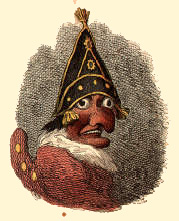
A new form of entertainment has reached Altdorf; a hand puppet or marionette theatre featuring the characters of Gaspar and his wife Gretchen as well as a menagerie of supporting figures. I believe that it traces its origins back to Tilea, although the name Gaspar surely originates from Kislev. For sure, the characters are as colourful as any Tilean and they dress and behave just as outrageously. My theory is that the show reached Kislev before Altdorf, and that is why the main character is called Gaspar. There some who claim that the puppets and the story they play out is a creation of Chaos, a lure to gain access to the minds of the children ... and if what I have observed at the secret screenings is true, the adults as well. For each and every person who attends this Gaspar und Gretchen puppet show is enthralled by the spectacle. Given a theory of involvement by the powers of Chaos, the show might have migrated from the Chaos Wastes to Kislev and then further into the Empire and down to Tilea.


The theatre is performed by a "Professor" sitting in a box or a booth equipped with a small stage. He uses puppets or marionettes and the play itself is a string of short episodes each depicting an interaction between two of the characters of the cast. Most often it is the rascal Gaspar together with one of his numerous victims that grace the stage. Gaspar is a symbol of The Great Jester of Old World folklore, and accordingly dresses as a jester in a colourful suit with bells on his hat. He has an enormous hooked nose that curves so as to almost meet his chin. It is almost a beak more than a nose. The puppet is armed with a stick as large as he himself is tall, and he finds great pleasure in using this to rain violence on the other characters of the play. His voice is a squawk, a distinctive and grating noise. This effect is achieved by the Professor using a contraption of weed and wood in his mouth while speaking.

Gaspar und Gretchen

The story varies somewhat between Professors, but the recurring theme is the same; Gaspar behaving totally irresponsible, fighting his wife Gretchen and dealing with their baby in the most outrageous ways imaginable. The cast also consists of a goblin, a hangman, a City Watchman and a powerful Chaos demon named Gideon. Another constant is Gaspar's punchline "That's the way to do it"! Gaspar triumphs in a series of encounters with the law but also with the forces of Chaos. The Goblin is a humorous aside, but the final scene is a showdown between Gaspar and Gideon, where the jester ultimately triumphs, exclaiming "Huzzah! Huzzah! I've killed the Demon"! Everything is shockingly humorous and performed with great comedic impact, intended to provoke laughter and shocked amusement.

Gaspar und Gideon

So is this Chaos trying to win another foothold in our beleaguered capital? If so it can only be Tzeentch, the Changer of Ways, who advocates such anarchy and wanton behaviour as that displayed by the puppets. And who is The Great Jester if not Tzeentch himself? But then again at the end of the play Gaspar defeats Gideon, a powerful Chaos Demon so maybe this is a show about how to defeat Chaos with Chaos. An intriguing tale for sure. I have no doubt that the Witch Hunters will try to put a stop to the puppet shows by burning every booth and Professor they find. They wait only for our Emperor to sign the suggested law banning these spectacles from performing in the Empire. But given the preponderance of nobles and artistocrats at the shows I have attended, I'm sure that Gaspar is safe for now. I'm not so sure that we are.

Adolphus Altdorfer
Nachexen 25, 2522


Of course, Gaspar und Gretchen is based on the adventures of Punch and Judy. The illustrations are by caracturist George Cruickshank and appeared in The Tragical Comedy or Comical Tragedy of Punch and Judy in 1828.

The possibilities for adventures involving Gaspar und Gretchen are endless. Is the show a conspiracy? Or is it harmless entertainment? Does it hide something sinister and forbidding, or is it a warning to The Empire about the coming of Chaos? And who are the Professors and where do they come from? And last but not least, what if the characters would encounter Gaspar und Gretchen in real life? The horror! The horror!

Magnus